Intensive outpatient programs (IOP) and partial hospitalization programs (PHP) are both intensive, structured, outpatient mental health treatment programs.
When you or a loved one is looking for help with a mental health or substance use disorder, it can feel overwhelming to try to decide which level of support you need.
Here, we break down the key differences among the program types to help you make an informed decision that meets your individual needs.
IOP vs PHP: What’s the Difference?
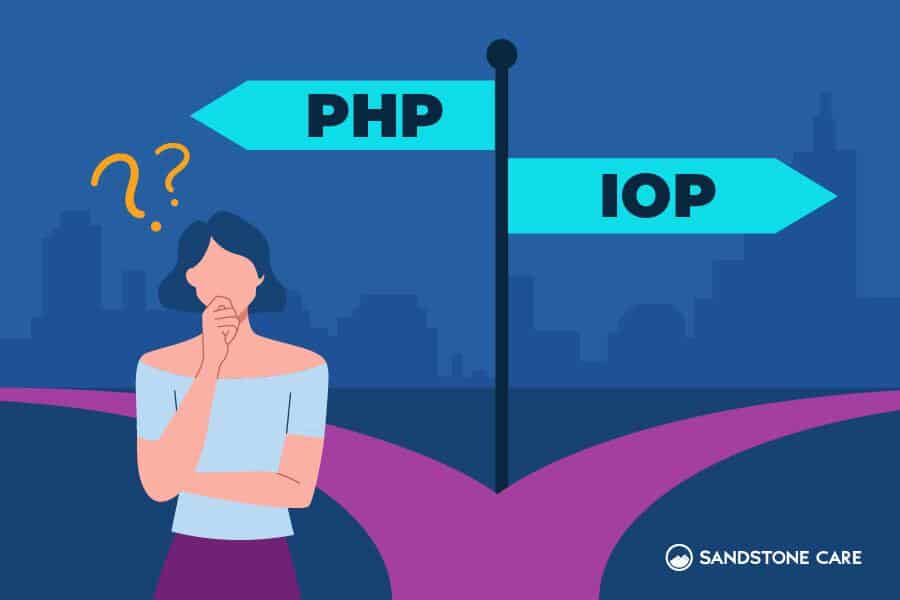
Both IOP and PHP are structured forms of outpatient care, but they differ in their intensity. PHP is more intense and IOP is less intense.
Outpatient care means you spend several hours at each one, then go home at night.
Going home in between therapy sessions is what makes these programs different from inpatient treatment or residential treatment, where you have 24-hour supervision.
What is an Intensive Outpatient Program (IOP)?
In an intensive outpatient program, or IOP, you receive structured therapy several hours a day, several days a week.
Programs often follow an evidence-based curriculum and loop between different mental health topics.
These programs can teach you how to reframe tough situations, regulate your emotions, and navigate triggers, cravings, and more.
What is a Partial Hospitalization Program (PHP) or Day Treatment?
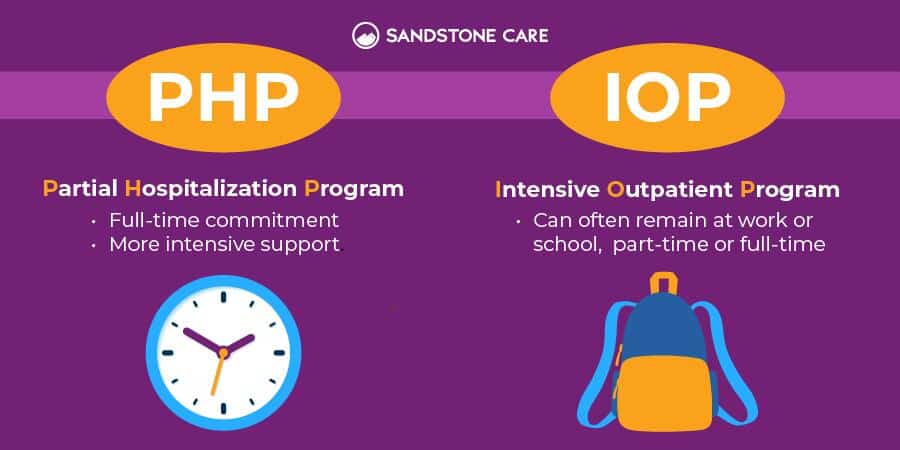
A partial hospitalization program (PHP), also sometimes called “day treatment”, is an outpatient treatment program for mental health or substance use with several hours of structured treatment most days of the week.
Like IOP, partial hospitalization programs still allow you the flexibility to return home each day after treatment.
PHP typically includes a mix of group therapy, individual therapy, and family therapy, along with psychiatric support and medication management when needed.
PHP is a step up in intensity from IOP but a step below inpatient hospitalization or residential care.
IOP vs PHP at a Glance (Time, Structure, and Support)
|
|
Both IOP and PHP include regular check-ins with mental health professionals. They may also use one or several different types of therapy.
Cognitive-behavioral therapy (CBT) and dialectical behavior therapy (DBT) are two common forms of therapy. Family therapy sessions are also often used.
Key Differences Between PHP and IOP
When comparing IOP vs. PHP programs, the main difference is the level of structure and support you need right now.
PHP is a full-time commitment and offers much more intensive support. With IOP, you can often remain at work or school, part-time or full-time, depending on when your sessions are.
Intensity & Time Commitment
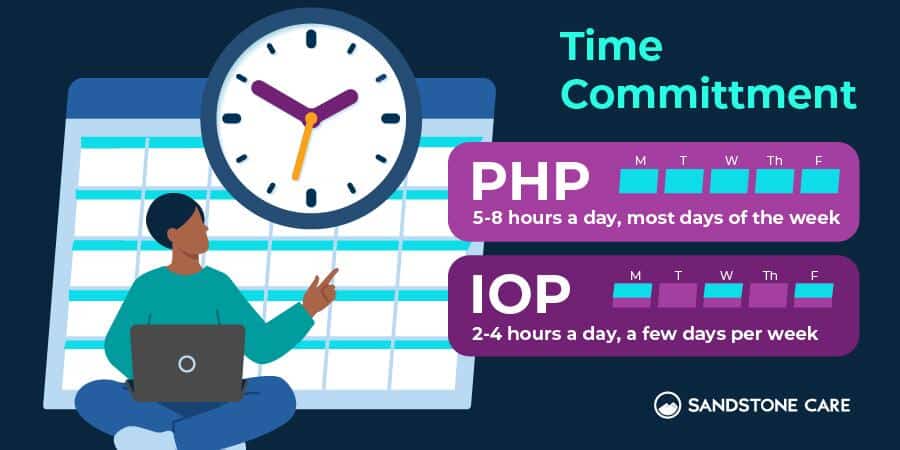
Intensity and time commitment are two key differences between PHP and IOP.
PHP: 5-8 hours a day, most days of the week
IOP: 2-4 hours a day, a few days per week
If symptoms significantly interfere with your daily life and ability to manage your daily responsibilities, a higher level of care, such as PHP, may be needed.
However, if you don’t want to take a full leave from school or work and are looking for a moderately structured program, then IOP may fit your specific needs.
Daily Structure & Clinical Supervision
Both IOP and PHP provide structure and clinical oversight. However, IOP provides less than PHP.
PHP provides a more structured treatment setting and more intensive care than IOP, as you go to therapy most days of the week for longer sessions. Additionally, with PHP, a psychiatric prescriber is often part of the team to start, stop, or adjust medications as needed.
With IOP, you have a lot more independence and time between sessions, since it isn’t every day and the sessions are shorter. Sometimes, IOP sessions are offered online, so that you can do them from home.
Flexibility for Work & School
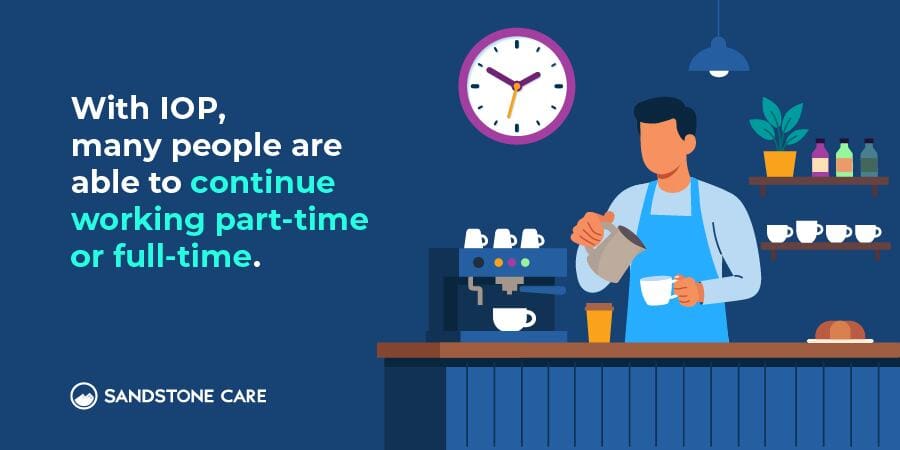
With IOP, many people:
- Continue in work part-time or full-time, depending on when their IOP is scheduled
- Can stay enrolled in school without taking a semester off
- Maintain family and social commitments
If you are a student, you will likely need to take a semester off to focus on your treatment in PHP. And if you are working, you will likely need to take a leave of absence. Most PHP programs run a full-day schedule, Monday through Friday. Some programs also include the weekends.
Living Situation & Support at Home
Your home environment matters a lot during treatment. Consider the support you have and the support you need.
PHP is best if:
- You don’t need 24-hour supervision and can keep yourself safe in between sessions
- You have a safe and stable living situation
- You have a support network at home
- You need more structured support than IOP
If your home environment is unstable or you don’t feel safe there, but you need a higher level of care, then inpatient treatment or residential treatment might be a better fit.
IOP is best for someone who is independent most of the time and has a reliable support system at home.
Keep in mind that there are several ways to find a supportive environment in the community, too, outside of just the home. For example, if you struggle with substance abuse, peer support groups with a peer counselor can help you with relapse prevention.
Typical Treatment Journey (Step-Up vs Step-Down)
It is essential to understand that your treatment isn’t always linear. In fact, most of the time, the progress you make, and the setbacks you face will look like a zigzag.
You may hear terms like a step-up in care or a step-down. What that means is whether someone needs to step up to a higher level of care, such as moving from IOP to PHP. Or if they are ready to step down into a less structured level of care, such as moving from PHP to IOP.
For example, some people might:
- Start in PHP, then step down into IOP
- Start in PHP, and then step up into residential or inpatient care
- Start in inpatient care, then step down into IOP
For someone who requires significant mental health support, it might look like an acute inpatient stay to detox or stabilize, then residential treatment for continued 24/7 support in a less restrictive environment than a psychiatric hospital, followed by PHP for continued oversight and support, then IOP, and finally weekly outpatient therapy.
However, at any point, you might require a higher level of care and need to move back up a level before moving down. Additionally, some people are ok going straight to IOP after an inpatient stay and don’t require residential treatment or PHP. It all depends on your unique needs.
Who is PHP Best For?
PHP is best for those who require a higher level of care to maintain safety and focus on treatment goals, but do not require 24/7 supervision and care.
Signs You May Need PHP
Signs that you may need PHP include:
- You were recently discharged from an inpatient hospitalization or a residential program and still need a higher level of care
- Your symptoms feel overwhelming or unsafe
- You are experiencing severe depression or anxiety
- You’ve experienced frequent relapses
- You need medication adjustments
- You are having a hard time functioning in your daily routine
PHP offers intensive support and more comprehensive care than IOP, without requiring full hospitalization or a 24/7 residential program.
When PHP May Not Be the Right Fit
PHP may not be the right fit, and you may need a higher level of care if:
- You require 24-hour supervision
- You are unable to maintain safety
- You require medical detox
Additionally, PHP may not be the right fit, and a lower level of care might be better if:
- You plan to remain in work or school
- You do not require all-day programming
- You don’t need medication adjustments, or you have a provider whom you meet with separately for medication needs
For those who require a higher level of care, inpatient programs or residential treatment might be more appropriate. For those who require a lower level of care, IOP may be the most appropriate.
Cost, Insurance, and Logistics in IOP vs PHP
Cost is often a major factor in the PHP vs IOP decision. Most insurance plans will cover both options, but the cost can vary significantly.
What Impacts Cost
Factors that impact cost include:
- Insurance coverage vs. private pay
- Number of treatment days per week
- Duration of the treatment program
- Whether medication management is included
- Location
Since PHP involves more hours and treatment days, it is typically more expensive than IOP. However, just because it costs more does not mean that the out-of-pocket cost is more. Cost will depend on your plan’s deductible and coverage.
It is best to speak with an admissions counselor to get an estimate and better understand your out-of-pocket costs.
How Insurance Coverage Typically Works
Most major insurance plans cover both PHP and IOP under behavioral health or mental health treatment benefits.
Coverage depends on:
- Medical necessity
- Diagnosis
- Pre-authorization requirements
- In-network vs/ out-of-network programs
How to Verify Benefits
At Sandstone, we do our best to make understanding the insurance process as simple as possible. We offer an insurance verification tool on our website to help you understand your benefits.
The easiest way to verify coverage is to fill out our online form found on the insurance verification page. To speak to our admissions team, call us at (888) 850-1890. We are here to help and are happy to answer any questions you have about the admissions process and insurance benefits.
Get a Professional Assessment to Confirm the Right Level of Care
If you are unsure what level of care is appropriate for you or your loved one, talk to a mental health professional.
If you are transitioning from inpatient care, ask to speak to a social worker or discharge planner for help coordinating whether PHP, IOP, or individual therapy is best for you.
If you are not currently in treatment, your primary care provider, mental health prescriber, or therapist are good resources.
Finally, if you are not connected to any mental health resources, call us at (888) 850-1890. At Sandstone, you do not need a referral to access our services. We offer several levels of care and can help you understand which ones meet your needs.
We have locations across the country as well as virtual options for some of our services. At our residential treatment centers, it is common for clients to come to us from all over the country for care.